

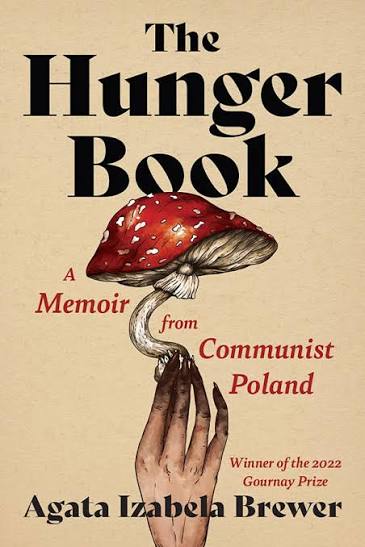
About This Book
Agata Izabela Brewer tells stories of her Polish childhood: foraging for food, homemade potato vodka that was used as currency, the warmth of her grandparents’ love, and the scent of mushrooms drying, all set against life behind the Iron Curtain of 1980s Poland.
That world unfolds in a tiny apartment, shared with an alcoholic single mother, while the effects of nuclear disaster from nearby Ukraine cast their shadow over daily life. Recipes from her childhood, such as blood sausage, are included, as are her adventures foraging for mushrooms. Food becomes a double-edged sword, a comfort and a reminder of the deprivation and hunger she suffered.
Brewer reflects on all of this from an immigrant’s vantage point, writing from Indiana, where she struggles with the echoes of her past while striving to convince her children to hold on to their Polish heritage rather than ignoring it as they prefer to do. The book moves between childhood and adulthood throughout, each chapter organized by food type, the first being mushrooms and the stories that relate to that kind of food. The opening chapter opens with the haunting presence of her mother, who follows her all the way across the Atlantic Ocean.
The Trauma of Growing Up in an Alcoholic Household
This book so beautifully captures the instability of growing up in an alcoholic household: the never knowing how you might find your volatile and absent parent, the absolute chaos and uncertainty of every day, and the traumatic aftereffects that last a lifetime.
Having grown up in a household dominated by my father’s severe alcoholism, this book resonated with me deeply. Like my father, Brewer’s mother was driven to her alcoholism by her own trauma of being a single mother in Communist Poland.
In the chapter titled “Roots,” she begins: “When I first began writing this essay I wanted to write about mother, but I could not… instead I chose to write about roots. It was a dissociative strategy that so many adult children of alcoholics use, often unconsciously, to avoid the anguish of revisiting traumatic moments.”
Brewer illuminates the confusion of loving such a parent. She describes her mother with devastating honesty:
“She’s fear and anger, sometimes simmering just under the surface, invisible only as her pulsating cheekbones and narrowed eyes… She’s a shard of glass aimed at my chest. She is 60 proof breath and slurred consonants when ethanol mollifies her fury. She’s a sleeping beauty on musty bed sheets, a body suspended in mid-air on a leather belt attached to bathroom pipes…”
But then she adds what many adult children of alcoholics need to hear, that their parent was so much more than an addict:
“She was a good friend to other lost souls, other broken people, neighbors with addictions and mental disorders, her students who struggled in broken homes, her lovers who appreciated her subtle beauty and voracious appetites, lost and sick animals that came to our apartment to heal. Mother loved us, in her own way and as much as her disease allowed her. She probably loved us much more than she loved herself.”
Reading this, I consider my own father, who could be hostile, charming, and loveable all in the same moment, and I knew that he loved me, as much as his disease would allow him to.
Brewer also speaks to the science of inherited pain, writing about epigenetics as she believes she inherited her mother’s trauma on top of her own: “They say that trauma gets lodged in our genes and takes root, that it is passed down the generations, influencing our identity, undermining our resilience, betraying us in the least expected moments.” She describes her own symptoms of trauma such as panic attacks and nightmares.
Brewer captures how this trauma so readily transports us back into the past. When she gets a call from her mother as an adult, she writes: “I am a six-year-old girl with a disheveled braid, tears streaming down on mother’s dirty jacket as I try to prop her up and make her walk again while she remains prone on hard pavement.” She shows how adult children of alcoholics suffer from cumulative trauma and PTSD — “a long-lasting shock engraved in our bodies.”
Brewer’s hunger for her mother’s affection may be even greater than her hunger for food, and as she acknowledges, her mother’s hunger was all-consuming: “There is no greater hunger in the world than that of an addict.” It wedged itself into her stomach, and she learned to navigate “mother’s land of mine.”
The family was never emotionally sober. The actual drunk was mother, but they were all drunk in other ways, living in denial, constant cover-up, and shame, careening from one intense emotion to another. Her brother tells her: “You think things have changed, but we are still those kids standing at attention in pajamas in the middle of the night, scared and unmoving.”
One of the book’s most haunting images is the carp swimming in her bathtub. Brewer writes: “I think I spent so much time with the carp in the bathtub because I sensed a kindred spirit in the fish, trapped within the iron walls, getting enough oxygen to stay alive but barely, and swimming in circles without direction, with only one goal in mind: to survive.”
It is a metaphor for being trapped, and for the quiet, determined will to survive that runs through this entire memoir.
The Healing Value of This Book
The healing value of The Hunger Book is real, and it works in three ways.
First, identification. This book lets readers see their own experience on the page, which is the foundation of bibliotherapy.
Second, validation. It tells adult children of alcoholics that their feelings make sense, that the chaos they grew up in was not their fault, and that its aftereffects are real and shared.
Third, understanding. Through concepts like epigenetics, Brewer gives language to the idea that trauma is passed down through generations, influencing our identity, undermining our resilience, and betraying us in our least expected moments.
For anyone carrying the legacy of an alcoholic household, this memoir is a gift. It does not offer easy answers. It offers something rarer: the knowledge that you are not alone, and that survival, swimming in circles, barely breathing, with only one goal in mind, is itself a kind of grace.


Leave a Reply