
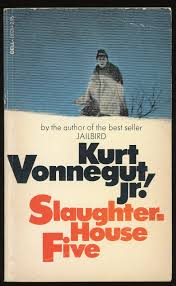
Slaughterhouse-Five by Kurt Vonnegut is a landmark anti-war novel that blends satire, science fiction, and historical fiction to explore the psychological impact of war trauma. Through the experiences of Billy Pilgrim, a survivor of the Dresden bombing in World War II, Vonnegut offers one of the most powerful literary portrayals of PTSD in fiction.
The novel’s famous opening line—“Billy Pilgrim has come unstuck in time”—has become practically synonymous with post-traumatic stress disorder. Slaughterhouse-Five can be a profound source of comfort and healing for trauma survivors, particularly war veterans. During the Vietnam War, The New York Times described the novel as a kind of self-help manual for psychic pain. A Vietnam veteran once praised the book, describing himself as “unstuck” at times. Vonnegut’s daughter later revealed that her father experienced PTSD himself and that he wrote the novel in an effort to save his own life. In doing so, he may have saved many others. Veterans from later conflicts, including Iraq, have also spoken of turning to Vonnegut’s novel for solace, finding that it helped lessen feelings of guilt, grief, and emotional pain associated with combat trauma.
Billy’s PTSD manifests through his nonlinear experience of time. He moves unpredictably through different moments of his life—one moment a young soldier in the war, the next an older man approaching death, or even his own birth. This fragmented structure mirrors the way trauma affects memory, pulling sufferers out of the present moment through trauma triggers. In the novel, Billy is triggered by a barbershop quartet singing at his wedding anniversary in 1967; their harmony reminds him of the guards who stood outside the slaughterhouse where he and other prisoners of war were held. Other recurring PTSD triggers include specific color combinations—ivory-white and orange-black—and evocative smells such as mustard gas and roses. On many levels, Billy appears to be reliving his trauma through nightmares or subconscious flashbacks. When a siren goes off, he expects “World War Three.” His constant movement through time places him in a “constant state of fright,” a condition familiar to many people living with complex trauma.
Billy’s travels to the planet Tralfamadore reveal an intense need for escapism, a common coping mechanism among those with PTSD. Like many trauma survivors, he creates a fantasy world where painful memories of war cannot reach him. His frequent dissociation, a hallmark symptom of severe trauma, further illustrates his psychological fragility. He fears he might “shatter like glass.” Unlike the hypervigilance often associated with PTSD, Billy appears dazed and emotionally numb. When he arrives at a POW camp, and his coat catches fire, he barely reacts, prompting a British soldier to remark, “This isn’t a man. It’s a broken kite.” The first time Billy becomes unstuck in time is in 1944, during the Battle of the Bulge, when he becomes a “dazed wanderer.” Even when shot at, he simply stands still.
Billy also exhibits suicidal ideation, another tragic reality for many people suffering from post-traumatic stress disorder. Rather than fearing death, he often welcomes it, resenting those who rescue him from it. Hints of this appear even in his childhood, such as when he fears he might jump into the Grand Canyon. This suggests either early childhood trauma or, given the novel’s nonlinear view of time, trauma that reverberates across his entire life.
Vonnegut describes soldiers as “living moment to moment in a constant state of terror, thinking brainlessly with their spinal cords.” Modern trauma psychology supports this depiction. Trauma over-activates the amygdala, the brain’s fear center, while impairing the hippocampus and prefrontal cortex, which govern memory, emotional regulation, and logical thinking. Billy’s symptoms reflect this neurological damage. He cannot remember basic facts, such as his age, and he frequently cries for no apparent reason. Depression, nightmares, and sleep disturbances—all common in PTSD—are prominent in his life. Other POWs refuse to sleep near him because he harms them during his sleep. After the war, Billy commits himself to a mental hospital, highlighting the difficulty many veterans face when reintegrating into civilian life after combat trauma.
While hospitalized, Billy meets Eliot Rosewater, who introduces him to the science fiction writer Kilgore Trout. Billy becomes obsessed with Trout’s work, once again revealing the role of fantasy and science fiction as trauma coping tools. One of Trout’s novels, Maniacs in the Fourth Dimension, describes people whose mental illnesses cannot be treated because doctors can perceive only three dimensions. At the time Slaughterhouse-Five was published, PTSD was not yet a formal diagnosis. Vonnegut may have been commenting on how trauma survivors were misunderstood and left untreated.
The novel also explores free will and trauma. A Tralfamadorian compares human existence to a bug trapped in amber and notes that only on Earth do people believe in free will. Trauma survivors often feel similarly trapped, resigned to a life shaped by suffering and stripped of agency.
Readers may find healing through this novel by gaining insight into their own experiences of trauma and recognizing themselves in Billy’s suffering. From a bibliotherapy perspective, Slaughterhouse-Five demonstrates how literature can help heal trauma by offering language, metaphor, and validation. The idea of being “unstuck in time”—unable to remain fully present—resonates deeply with many trauma survivors. More than fifty years after its publication, Slaughterhouse-Five remains a profoundly relevant novel about PTSD, memory, and the human cost of war.
Grace Mattioli is the author of three novels: “Olive Branches Don’t Grow on Trees,” “Discovery of an Eagle,” and “The Bird that Sang in Color.” She is currently working on a memoir, “A Dragonfly Mosaic: My Journey from Fear to Love,” and several short stories. She lives in Portland, Oregon with her husband and her cats. Her books are available from all major online book sellers, including Amazon, Barnes & Noble, and Apple Books.


