

The Core Lesson: Struggling Against Pain Creates Suffering
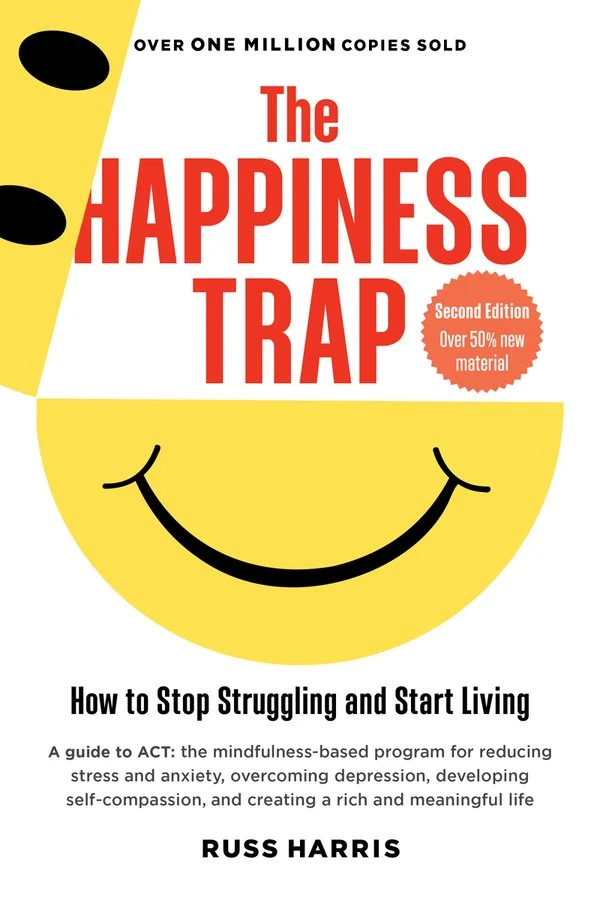
At its heart, The Happiness Trap teaches the same truth that Siddhartha discovers on the banks of the river: resisting pain is what turns pain into suffering. Harris argues that so much of our unhappiness doesn’t come from painful thoughts and feelings themselves, but from our constant, exhausting struggle to avoid, suppress, or fix them. We cannot live fully until we learn to accept our pain rather than fight it.
This idea resonated deeply with me. I came to understand this same lesson through my own lived experience, which I write about in my forthcoming memoir, What I Found When I Stopped Searching. Like Harris, I discovered that the harder I fought against my own difficult emotions, the more stuck I became. Real relief only arrived when I stopped struggling.
Mindfulness as the Foundation of ACT
Just as Siddhartha is rooted in mindful presence, The Happiness Trap is built on a foundation of mindfulness — cultivating a deep, non-judgmental awareness of our thoughts, emotions, feelings, and physical sensations. Rather than treating painful inner experiences as problems to be solved, Harris teaches readers to notice them, name them, and let them be.
“Life Is Difficult”: Accepting Pain as Part of Being Human
Harris opens the book with a deceptively simple statement: life is difficult. It’s a line that sets the tone for everything that follows. Embedded in those three words is the acceptance that pain is inherent to the human condition, and that we do ourselves no favors by clinging to the myth that happiness should be a constant, unbroken state.
It’s a sentiment that echoes the wisdom of Ecclesiastes 3:1 — “To everything there is a season, and a time to every purpose under heaven.” Both the book and the biblical verse point to the same truth: pain and joy, struggle and ease, are part of a natural rhythm, not a malfunction to be corrected.
Emotional Storms: A Concept I Know Intimately
One of the most striking metaphors in The Happiness Trap is the idea of the “emotional storm” — that overwhelming, all-consuming experience of being flooded by pain and anxiety. This is a concept I know intimately from my own life, and Harris’s compassionate, matter-of-fact way of describing it made me feel truly understood, not pathologized.
The Goal of ACT: Detach, Then Reorient Toward What Matters
According to Harris, the goal of Acceptance and Commitment Therapy is twofold:
- Detach from the distracting, negative thoughts and painful feelings our brains are naturally predisposed to generate.
- Reorient toward what actually brings lasting, meaningful satisfaction in life.
This isn’t about eliminating negative thoughts — Harris is clear that this is neither possible nor the point. Instead, ACT teaches us to change our relationship to those thoughts, so they no longer run the show.
Practical Tools: Dropping Anchor and Labeling Emotions
What I love most about The Happiness Trap is how practical it is. This isn’t abstract philosophy; it’s a toolkit.
Dropping Anchor is one of the book’s signature techniques. When caught in an emotional storm, Harris teaches readers to “drop anchor” by grounding themselves in the present moment: acknowledging the thoughts and feelings present, connecting with the physical body (feet on the floor, breath moving in and out), and expanding awareness outward to the surrounding environment. It’s a way of steadying yourself in rough emotional waters without needing the storm to pass first.
Labeling emotions, thoughts, and sensations is the other tool I return to again and again. Simply naming what’s happening — “I’m noticing anxiety” or “I’m having the thought that I’m not good enough” — creates a small but powerful distance between you and the experience. That distance takes the power out of it.
I’ve used both of these techniques throughout my days, especially during difficult moments, and they continue to serve me well.
Values and the “Away Moves” vs. “Toward Moves” Framework
Toward the end of the book, Harris broadens his focus from managing pain to building a meaningful life — specifically, by helping readers identify their core values and use them as a compass for living.
This connects back to a concept he introduces earlier in the book: away moves and toward moves. Away moves are actions that pull us away from ourselves — avoidance, numbing, distraction. Toward moves are actions that bring us closer to who we really are and what we truly value.
This framework has helped me develop a much keener awareness of which of my daily choices keep me connected to myself and my core values, and which ones quietly pull me away.
Final Thoughts: Why This Book Belongs in Any Healing Library
The Happiness Trap earns its place in this bibliotherapy series because it does what the best healing books do: it meets readers exactly where they are, in their pain, and offers a compassionate, workable path forward. Like Siddhartha, it doesn’t promise the elimination of suffering — it promises something better: the freedom that comes from no longer struggling against it.
If you’re navigating anxiety, emotional storms, or simply the difficulty of being human, this book — and the ACT principles it teaches — may offer the same grounding it has offered me.
Have you read The Happiness Trap? I’d love to hear which tool — dropping anchor, labeling, or the values work — resonated with you most. And if you haven’t yet, you can read more about my own healing journey in my memoir, What I Found When I Stopped Searching.
Grace Mattioli is the author of three novels: “Olive Branches Don’t Grow on Trees,” “Discovery of an Eagle,” and “The Bird that Sang in Color.” She is currently working on a memoir entitled “What I Found When I Stopped Searching.” She lives in Portland, Oregon, with her husband and her cats. Her books are available from all major online book sellers, including Amazon, Barnes & Noble, and Apple Books.


