

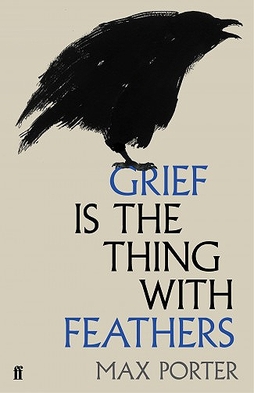
The first book in my bibliotherapy series explores a subject that often exists beyond language—grief, and our attempts to find comfort and consolation in its wake. In Grief Is the Thing with Feathers, Max Porter offers healing through prose written in poetic verse, crafting a story that feels more like a modern fable than a conventional work of fiction.
The narrative unfolds through multiple perspectives: the father (Dad), his two sons (the Boys), and Crow, whom I interpreted as grief itself, given form. In the book’s description, Crow is called an “antagonist, trickster, goad, protector, therapist, and babysitter,” a fitting array of roles for something as complex and contradictory as grief. Crow arrives to comfort a family shattered by the sudden death of its matriarch, and interwoven with Crow’s presence are fragmented reflections from each family member as they try to comprehend what has happened.
One passage resonated deeply with me, having lost loved ones suddenly myself:
“Four or five days after she died, I sat alone in the living room, wondering what to do. Shuffling around, waiting for shock to give way, waiting for any kind of structured feeling to emerge from the organizational bakery of my days… Grief felt fourth dimensional, abstract, faintly familiar. I was cold.”
Another passage that struck me comes from the Boys:
“Where are the strangers going out of their way to help, screening, plain bits of emergency glow-in-the-dark equipment at us to try and settle us and save us?”
My own mother died when I was fifteen. In the days immediately following her death, our house was filled with people bringing food, flowers, and tears of their own grief for the woman I called Mom. This line transported me back to the first time the house became empty again—and how that physical emptiness mirrored the hollowness I felt inside myself.
Toward the end of the story, Crow leaves once the family is ready to move forward. Before departing, Crow reminds Dad that his wife died from hitting her head. I interpreted this as Crow’s final act of mercy: absolving Dad of any lingering guilt and freeing him from the burden of imagined responsibility.
In the novel’s final scene, the point of view shifts from third person to first person as Dad and the Boys travel to a place Mum loved to scatter her ashes. Dad proclaims, “I love you! I love you! I love you!” into the wind. A few years ago, I, too, went to sea to scatter the ashes of a friend who had been part of my life for decades. While the experience was profoundly healing, it was also devastating—it marked the finality of my friend’s life on earth. Reading this scene and recognizing my own experience within it was, in itself, deeply therapeutic.
Grief Is the Thing with Feathers is a powerful example of bibliotherapy in action. It meets readers in the rawest stages of grief and offers solace through recognition and connection. Grief is also a central theme in my third novel, The Bird That Sang in Color. In the following passage, the protagonist reflects on her mental state after losing a loved one:
“When I was raw and broken, I’d lose time staring at whatever was in front of me while nothingness filled my mind—not the kind of nothingness that Buddhist monks aspire to; more like an off-pitch humming sound, colorless and without any texture. I felt like I was stuck between two worlds—that of the living and another one between here and the afterlife.”
Grief also runs through my upcoming memoir which centers on the death of my mother and other profound losses—all of them sudden and premature, the oldest occurring at age sixty. With each loss, I’ve learned more about the grieving process, from the physical consequences of endless tears—dehydration, muscle soreness—to the emotional necessity of letting grief move freely through the body.
I feel fortunate to be someone who has always known how to grieve, perhaps influenced by my Italian heritage. I do not hold back. I wail. I collapse. I pound the floor with my fists. In many cultures, this kind of grief is expected and honored. In others—like the United States, where I live—it is often suppressed. At my brother’s funeral, when I became hysterical, two people offered me a tranquilizer. I declined. I wanted to feel my pain—not only because I believe it is healthy, but because I believe grief is an expression of love.
Grief is love’s continuation. It is the visible thread that binds my soul to those who have crossed into the spirit world. It is comfort and consolation—and, paradoxically, the greatest beauty I have ever known.
Grace Mattioli is the author of three novels: “Olive Branches Don’t Grow on Trees,” “Discovery of an Eagle,” and “The Bird that Sang in Color, ” and several short stories. She is currently working on a memoir. She lives in Portland, Oregon with her husband and her cats. Her books are available from all major online book sellers, including Amazon, Barnes & Noble, and Apple Books.


