

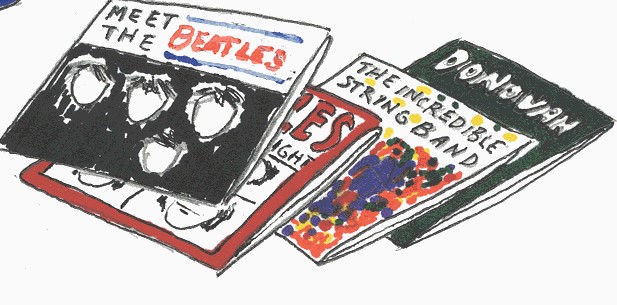
The Bird That Sang in Color is filled with music. Set against the emotional backdrop of family, memory, and coming of age, the novel uses iconic albums of the late 1960s and early 1970s to deepen character, establish time and place, and reveal the bond between siblings. This post highlights several of the albums featured in the book and the moments they shape.
The story opens in 1970 with Donna and her brother Vincent listening to Let It Be by the Beatles. While Vincent mourns the fact that this will be the band’s final album, Donna feels something very different—gratitude. She is grateful to have a brother who introduces her to music and opens up a larger world to her. As she reflects, “It was because of him that I knew so much about rock and roll, which made me pretty sure that I was the coolest eighth-grade girl in the whole town and possibly in the whole state of New Jersey.” Music becomes both a source of identity and a symbol of their closeness.
Later in the same chapter, Donna, Vincent, and their brother Carmen listen to one of my personal favorites: Benefit by Jethro Tull. Donna calls it a perfect album, describing how it allows her to step outside herself and forget where she is—and even who she is with—“one song seamlessly slipping into the next.” The album reflects the immersive, transportive power of music and how it can momentarily quiet the chaos of family life.
In the following chapter, Vincent returns home from college and insists that Donna listen to an album by a band he has recently discovered: The Incredible String Band. This British psychedelic folk group was truly in a class of its own. Donna studies the album cover, noticing a group of people standing beneath a tree, dressed in Renaissance-era clothing—a visual that mirrors the band’s mystical, otherworldly sound and Vincent’s expanding worldview.
Chapter Seven finds Donna visiting Vincent in Atlantic City, where he plays Troubadour by Donovan, a collection of earlier songs by the legendary singer-songwriter. For Donna, the album evokes childhood memories of listening to Donovan in Vincent’s old bedroom, reminding her how music anchors memory and preserves emotional connection across time and distance.
In Chapter Nine, Vincent introduces Donna to another one of my favorite albums: Liege & Lief by the folk rock band Fairport Convention. Widely considered a landmark album in British folk rock, it underscores the depth of Vincent’s musical knowledge and his desire to share what moves him most. Music once again becomes the language through which love, longing, and unspoken understanding are expressed.
Enjoy the following excerpt from Donna’s last visit with Vincent—a moment where music, memory, and sibling love converge in a way that defines The Bird That Sang in Color.
As soon as the first song started, I knew I loved it. As I listened, joy rose up inside of me like a geyser, and I couldn’t believe I had never heard this album before. I had something else by the same group called Heyday, and when I told this to Vincent, he said very seriously, “Stay away from Heyday,” like he was warning me against taking a drug with fatal consequences.
“They could only make music like this in the sixties,” he said through a smile.
“Like what?” I said.
“Like this. Like if they had rock and roll back in the Renaissance times, it would sound like this.”
“Yeah.” I tried to think of a more recent band that achieved this same kind of sound, and nothing came to mind, but that could have also been because I wasn’t up on anything new. Still, I felt sure he was right in saying that there was nothing recent like this out there. The first song finished and transitioned invisibly into the second one like a sunset changing the sky from bright orange to pale pink. I looked at Vincent listening and thought of all the great music I heard because of him. Hours of staring at album covers, while music, deep and light, fast and slow, sad and uplifting, moved me in a way beyond this world.
This post is part of my latest blog series on the artwork that inspired the family saga, The Bird that Sang in Color. The art featured in these posts comes from a sketchbook that belonged to my brother, Vincent, which I discovered shortly after his death. It had pictures he’d drawn of himself throughout various phases of his life. This pictorial autobiography caused me to wonder what pictures I’d have of myself by the end of my life, which motivated me to live more fully. In writing this novel, I was able to share this powerful realization with the world. This novel is the third book in the Greco Family books. Each one of these novels is told from a different family member’s point of view. This one is told from the perspective of the Greco family matriarch, Donna.


